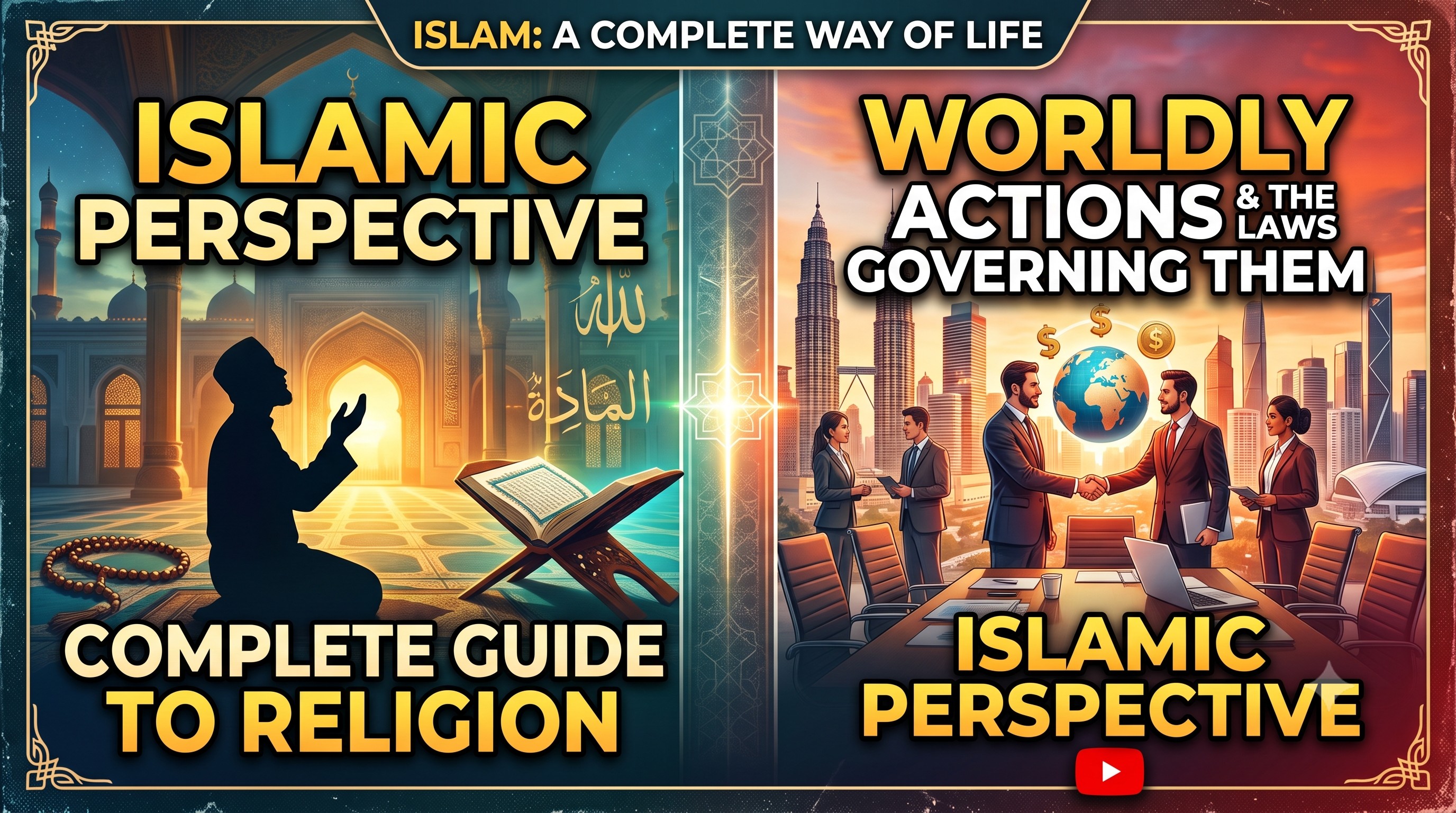
Religious and Worldly Actions in an Islamic Perspective: A Conceptual Explanation
A comprehensive guide based on contemporary Islamic thought.
1. Introduction: Contemporary Islamic Thought
In contemporary Islamic discourse, a precise conceptual framework is essential for navigating the relationship between religious and worldly actions. Because Islam functions as a comprehensive way of life, it provides guidance for the entirety of human activity. However, modern complexities make it necessary to deeply understand the distinct legal and philosophical differences between the laws of worship and the laws governing worldly affairs.
2. Religious and Worldly Actions: An Overview
There is a common, superficial view that religious actions (such as Salah, Fasting, and Hajj) and worldly actions (such as Business, Education, Marriage, and Transport) are entirely inseparable in Islam. It is often argued that in an Islamic society, all civic laws—whether governing healthcare or infrastructure—must be derived from religious texts, leading to the assumption that all worldly actions are inherently identical to acts of worship.
Key Thought: Because Islam is a holistic way of life, it promotes an integrated view of human existence. Engaging in ethical business or caring for one's family are indeed good deeds that earn rewards from Allah, just like prayer. However, integration does not mean they share the same legal framework.
3. Legal Nuances and Deeper Understanding
While these two spheres align in their ultimate purpose—seeking the pleasure of God—Islamic Jurisprudence (Fiqh) draws subtle but critical distinctions between them.
While divine law is infallible, human application in worldly affairs is subject to interpretation. In matters such as the legal age of marriage, women serving as judges, or political leadership structures, classical Imams have held varied opinions. Confusing human, rational deductions (Ijtihad) with absolute divine commands—and declaring a single human opinion as the "only true Islam"—creates unnecessary rigidity and confusion.
4. Perspectives of Classical Scholars
Classical Islamic scholars clearly distinguished between religious interests (Masalih al-Deen) and worldly interests (Masalih al-Duniya):
Imam al-Ghazali (Rah): Explained that fulfilling worldly interests is the prerequisite for many Islamic laws. Religious duties can only be properly protected and practiced if worldly structures, like a stable economy, are functioning smoothly.
Imam al-Shatibi (Rah): Emphasized that while both are vital, priority must ultimately be given to core religious interests when absolute conflicts arise.
Imam al-Mawardi & Imam al-Sarakhsi: Both noted in their classical texts that the most noble societal state is achieved when worldly progress and religious principles are aligned and reformed together.
5. The Fundamental Objectives of Islamic Law (Maqasid al-Shari'ah)
All Islamic legislation is built upon protecting five essential human needs (Dharuriyyat al-Khams):
Religion (Deen)
Life (Nafs)
Intellect (Aql)
Lineage / Family (Nasl)
Wealth (Mal)
Among these five, the preservation of "Religion" primarily deals with acts of worship and faith. The remaining four directly govern human worldly interests, proving that the Shari'ah places immense value on human welfare on Earth.
6. Ibadat (Worship) vs. Mu'amalat (Worldly Affairs)
To manage these objectives, scholars split Islamic law into two primary categories:
Category | Definition | Fundamental Legal Rule | Example |
Ibadat (Acts of Worship) | Acts performed in direct submission to God. The underlying logic or exact ratios cannot be fully decoded by human intellect. | Tawqeefi (Prohibition): A ritual is forbidden unless there is clear, explicit text in the Quran or Sunnah authorizing it. | We cannot logically explain why Maghrib prayer is exactly 3 Rak'ahs. |
Mu'amalat / Adat (Worldly Actions) | Laws governing transactions, customs, and social welfare, which are entirely open to human reasoning and context. | Ibaha (Permission): An action is permissible by default unless there is an explicit religious text prohibiting it. | Adjusting modern agricultural Zakat calculations based on current equipment expenses. |
7. Siyasah Shar'iyyah (Administrative Laws)
Prophet Muhammad (PBUH) fulfilled multiple roles: he was the Messenger of God, but he was also a statesman and community leader. Many of the administrative procedures he introduced—such as specific tax collection methods or the appointment of local governors—fall under Siyasah Shar'iyyah (contextual administrative law).
Islam inherently allows for flexibility, evolution, and reform in these administrative spheres to serve the public interest (Maslahah) as times, technologies, and circumstances change.
8. Conclusion
The nobility and timelessness of Islam are established through its immutable beliefs, core acts of worship, universal moral virtues, and definitive prohibitions (such as the bans on interest, alcohol, and injustice). Islam should not be defined by or restricted to the fluid, changing differences of opinion found in minor worldly applications.
While both religious and worldly actions can earn God's pleasure when done with the right intention, a mature Islamic perspective requires us to act with a clear understanding of the legal and conceptual differences between the two.
E-Book Dowload
https://mishkath.org/ebooks?language=english